
A business can be profitable and still run out of money.
That sounds contradictory, but it happens all the time. Profit and cash flow measure two different aspects of your business’s financial health, and understanding the difference can help you make much better financial decisions.
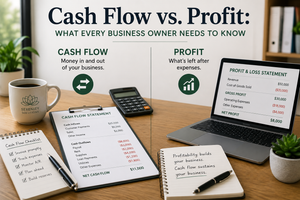
Profit tells you whether your business is earning more than it spends over time. Cash flow tells you whether you have enough money available when you actually need it.
You need both.
In this post, we’ll break down the difference between cash flow and profit, explain why the numbers don’t always move together, and look at ways to improve both.
What Is Profit?
Profit is the amount left after expenses are deducted from revenue.
At a basic level:
Revenue – Expenses = Profit
But there are different levels of profit on your Profit and Loss Statement.
Gross profit is revenue minus the direct costs associated with producing your goods or services.
Net profit is what’s left after the business accounts for its other expenses.
If your business consistently generates a profit, that’s a good sign. It means your business model is producing more revenue than expenses over time.
But here’s where things get interesting:
Profit on your P&L does not necessarily mean that money is sitting in your bank account.
That’s where cash flow comes in.
What Is Cash Flow?
Cash flow tracks the actual movement of money into and out of your business.
Cash comes in when customers pay you, financing is received, or assets are sold. It goes out when you pay employees, vendors, loan payments, taxes, equipment purchases, and other obligations.
A Statement of Cash Flows generally divides those movements into three categories:
- Operating activities: Cash generated or used through the company’s primary business operations.
- Investing activities: Cash related to purchases and sales of long-term assets and investments.
- Financing activities: Cash associated with borrowing, repaying debt, owner or shareholder contributions, and distributions.
The important distinction is timing.
Your financial statements can show revenue or expenses before—or after—the related cash actually moves. That timing difference is one reason your profit and bank balance rarely match.
If cash flow is an ongoing challenge in your business, our Cash Flow Management 101 guide goes deeper into managing those inflows and outflows.
Cash Flow vs. Profit: What’s the Difference?
Here’s the simplest way to think about it:
| Profit | Cash Flow |
|---|---|
| Measures revenue against expenses | Tracks cash moving in and out |
| Helps measure profitability | Helps measure liquidity |
| Appears on your Profit & Loss Statement | Appears on your Statement of Cash Flows |
| Helps answer, “Are we making money?” | Helps answer, “Do we have the cash to pay our obligations?” |
Neither number tells the whole story by itself.
A business with plenty of cash today isn’t necessarily profitable. Likewise, a profitable business may not have enough cash available to pay tomorrow’s bills.
Business Owners Need to Understand Both
Profit Shows Whether the Business Model Is Working
Over time, a business needs to generate profit to remain sustainable.
Profit allows a company to reinvest, build reserves, pay owners, reduce debt, and fund future growth. Tracking profitability also helps you determine whether your pricing and expenses make sense.
If revenue keeps climbing but profit doesn’t, that’s a signal worth investigating.
Cash Flow Determines What You Can Do Right Now
Cash flow is much more immediate.
Payroll doesn’t care that a customer owes you $20,000. Your electric bill doesn’t care that you just completed your most profitable month ever.
Those bills require cash.
That’s why a business owner who looks only at the P&L—or only at the bank balance—is working with an incomplete picture.
Our Financial Health Check-Up for Small Business Owners walks through several other numbers you should review alongside cash flow and profitability.

Why Profit and Cash Flow Don’t Always Match
Several common business situations can create a big difference between the two.
1. Customers Haven’t Paid You Yet
Suppose a contractor completes a $25,000 project and invoices the customer.
Depending on the business’s accounting method, that revenue may appear on the P&L before the customer actually pays the invoice. The company can show a profit while still waiting for the cash.
Meanwhile, payroll, materials, insurance, and other expenses still have to be paid.
This is why accounts receivable management can have such a significant effect on cash flow.
2. You Make a Large Purchase
Suppose your company buys an expensive piece of equipment.
The cash may leave your bank account immediately, while the accounting treatment of that purchase can affect your financial statements over a much longer period.
The result?
A significant reduction in cash doesn’t necessarily create an equally large reduction in profit during the same period.
3. You Make a Loan Payment
Loan payments are another common source of confusion.
The interest portion is generally an expense, but repayment of the principal reduces a liability on the Balance Sheet rather than appearing as an expense on the P&L.
So you can make a large loan payment, watch your bank balance drop, and wonder why your P&L barely changed.
Nothing is necessarily wrong with your books. You’re simply seeing the difference between cash movement and profitability.
4. Your Business Is Seasonal
Seasonal businesses may generate most of their annual profit during a relatively short period.
A strong year overall doesn’t guarantee adequate cash during the slower months.
That’s why seasonal businesses need to think beyond annual profitability and plan for when money will enter and leave the business.
How to Improve Cash Flow
You can’t manage cash flow effectively if you’re only looking at today’s bank balance.
Start with a few basic practices.
Create a Cash Flow Forecast
Estimate your expected cash inflows and outflows over the coming weeks and months.
You don’t need a perfect prediction. The goal is to identify periods when cash could become tight before you get there.
Invoice Promptly
The longer you wait to invoice a customer, the longer you’ll probably wait to get paid.
Send invoices promptly, establish clear payment terms, and consistently follow up on overdue accounts.
Review Vendor Terms
When appropriate, ask suppliers about payment terms that better align with your cash cycle.
You don’t necessarily want to pay everything as quickly as possible. You want a predictable payment system that lets you meet your obligations without unnecessarily straining working capital.
Build Cash Reserves
Strong months are an opportunity to prepare for weaker ones.
Setting aside cash can help your business absorb seasonal slowdowns, unexpected repairs, delayed customer payments, and other disruptions without immediately turning to credit.
How to Improve Profitability
Cash flow deserves attention, but it can’t fix an unprofitable business model.
Know Your Margins
Don’t stop at total revenue.
Look at gross profit, net profit, and the profitability of different products, services, jobs, or customers when your bookkeeping system allows it.
Review Expenses
Look for expenses that have increased over time or aren’t producing enough value for the business.
The goal isn’t to slash every cost. It’s to make sure the money you’re spending supports the company’s operations and goals.
Evaluate Your Pricing
Growing sales won’t solve a pricing problem.
If your costs have increased but your pricing hasn’t kept pace, you can work harder, generate more revenue, and still watch your margins shrink.
Understand What Actually Makes Money
Not every service, product, or customer contributes equally to profitability.
Accurate bookkeeping can help identify which parts of your business are performing well—and which ones may need a closer look.
That’s one of the reasons we consider accurate bookkeeping a tool for financial decision-making, not simply recordkeeping.
Use Your Financial Reports Together
Three financial statements give you different views of the same business.
Profit & Loss Statement
Your P&L shows revenue, expenses, and profitability over a specific period.
Use it to monitor trends in sales, margins, and expenses.
Balance Sheet
Your Balance Sheet shows what the business owns, what it owes, and its equity at a particular point in time.
This is where you’ll see assets such as cash and accounts receivable alongside liabilities such as loans and credit cards.
Statement of Cash Flows
The Statement of Cash Flows explains how cash changed during a particular period through operating, investing, and financing activities.
Looking at these reports together gives you a much more complete understanding of the business than any one report can provide by itself.
How Serenity Solutions Can Help
At Serenity Solutions, we help small business owners understand what their financial records are actually telling them.
Good bookkeeping should do more than keep your transactions categorized. It should give you reliable information you can use to run your business.
Our bookkeeping services can help you:
- Maintain accurate, current financial records
- Monitor accounts receivable and accounts payable
- Track cash flow and profitability
- Review financial reports regularly
- Identify trends before they become bigger problems
- Build better financial systems as your business grows
The Bottom Line
Here’s the distinction worth remembering:
Profit tells you whether the business is making money. Cash flow tells you whether the money is available when you need it.
A healthy business needs both.
If you’re profitable but constantly short on cash, you need to understand where the cash is going and when it’s moving. If you have plenty of cash but aren’t generating sustainable profits, you need to understand whether the underlying business model is working.
And if your financial reports can’t answer those questions, that’s a bookkeeping problem worth solving.
Take our Business Financial Health Scorecard to see where your financial systems are strong and where you may have gaps.
Or contact Serenity Solutions to learn how better bookkeeping can give you greater visibility into your cash flow, profitability, and overall financial health.